
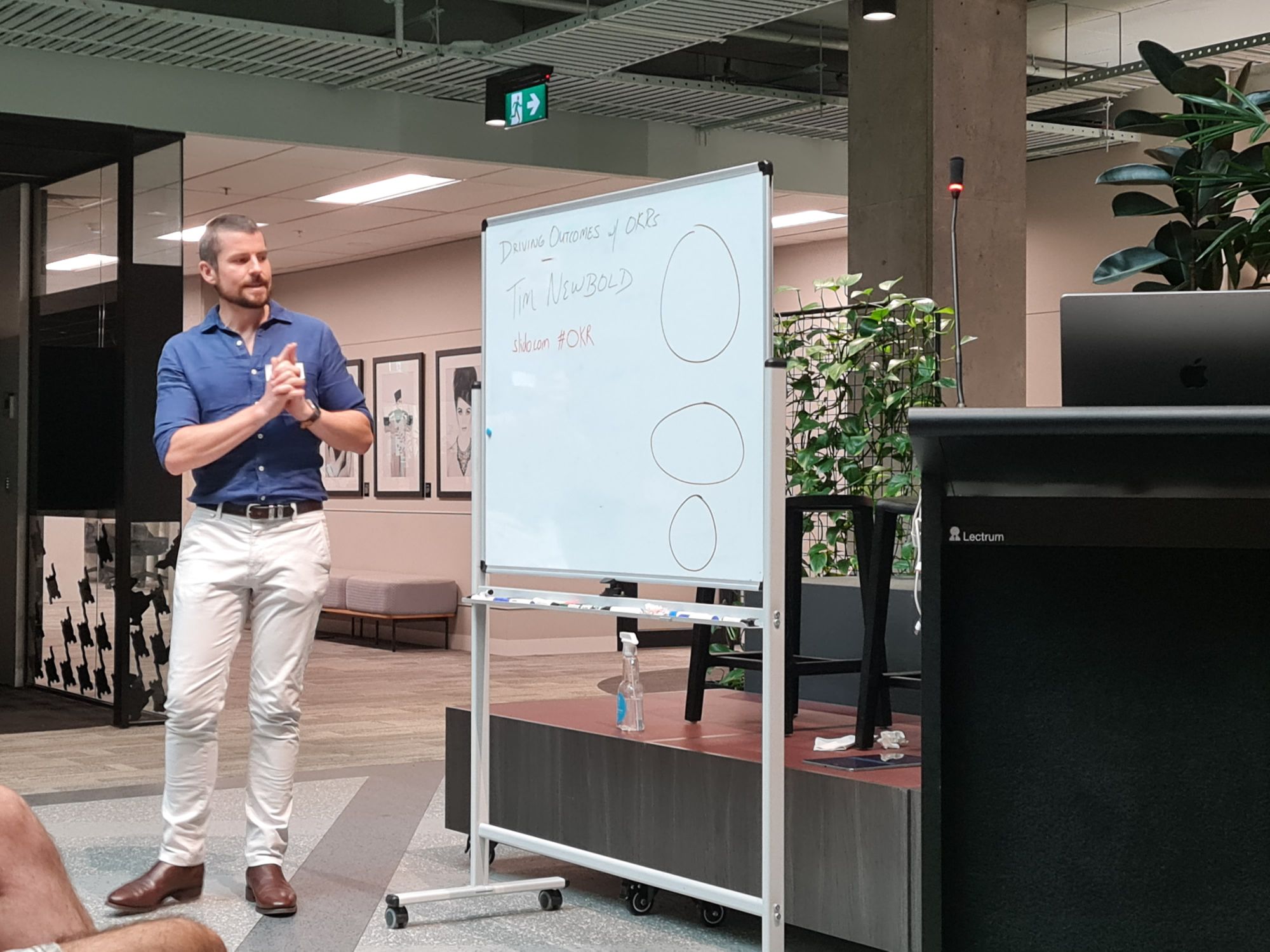
A summary of a talk by Tim Newbold, Founder and OKR coach at OKR QuickStart

There’s a famous psychology experiment where dogs were trained to distinguish between a circle and an ellipse. Reward the circle, shock the ellipse – simple enough. Then the researchers slowly began warping the shapes, making the circle more elliptical and the ellipse more circular. The dogs handled it for a while. But eventually, when the shapes became indistinguishable, the animals didn’t just give up. They became frustrated, confused and aggressive.
It’s a striking parallel for what happens inside organisations when teams operate without clear direction. Conflicting messages, moving targets, misaligned priorities – they don’t just reduce performance. They put people in a genuinely difficult psychological position. Creating strategic clarity and setting goals that are measurable and coherently linked is one of the most meaningful things a leadership team can do for the humans in their organisation.
That’s the real reason OKRs matter.
A Quick History
OKRs – Objectives and Key Results – trace back to the 1960s and Andy Grove at Intel. During an intense period of competition (most famously with Motorola), Grove realised that the only path forward was to get product, engineering and marketing moving as a single coordinated unit. The OKR framework was his answer.
Created by Intel in a move that led them to winning the original chip wars. From there the method spread through the venture capital world, particularly through John Doerr, who brought it to early-stage companies including Google. The framework’s association with high-growth tech startups cemented its reputation – but it has since travelled well beyond Silicon Valley. OKRs are now used in flooring businesses, logistics companies, financial services and large enterprises across industries.
OKRs Are Not Strategy
This is probably the most important distinction to get right before you start.
Strategy, done properly, begins with a clear diagnosis of a specific problem or challenge – not a vague aspiration. Richard Rumelt’s work on this is worth reading (both Good Strategy Bad Strategy and his more recent The Crux are excellent). A real strategy names a problem, states a guiding principle for addressing it and commits to a set of actions. Most so-called “strategies” fail this test. “We will deliver the best service and experience for our customers” could apply to almost any business in any sector. It’s not a strategy; it’s filler.
OKRs live one layer below strategy. If strategy is your flight path – your unique route from where you are to where you want to be – then OKRs are the discrete stages of that journey. The first stage might be getting off the ground. The next might be reaching cruising altitude. You’re not trying to fly the whole route in one OKR cycle; you’re making measured, sequential progress.
What an OKR Actually Looks Like
An OKR has three parts: an objective, key results and initiatives.
The objective is qualitative and inspiring. It articulates the problem or opportunity and gives the team a sense of direction and purpose. A good objective for a product team might be: Make our customers our biggest advocates. It’s clear, it’s energising and it suggests what kind of progress matters.
Key results are quantitative measures of progress toward the objective. For the example above:
- Increase trial-to-paid conversion from 5% to 7%
- Increase first call resolution from 75% to 90%
- Increase referral rate from 2% to 3%%
These are not to-do items. They don’t describe what you’ll do – they describe what you’ll see if you’re succeeding. The distinction matters enormously and it’s where most teams go wrong.
Initiatives are the actual work – the features you’ll ship, the experiments you’ll run, the processes you’ll change. These live underneath the key results. A useful check: if your “key result” could appear on a project plan or sprint backlog, it’s probably an initiative, not a key result.
OKRs vs KPIs: The Most Common Confusion
OKRs are about driving change. KPIs are about maintaining health.
Think of it like a rocket ship. The OKR tells you whether you’re making progress on the journey – how far you’ve travelled, at what velocity. The KPIs are the dashboard metrics that tell you whether the rocket is healthy enough to keep flying – temperature ranges, fuel levels, structural integrity. You need both.
If a KPI goes red, you don’t just ignore it in service of the OKR. You address the problem – which may mean the OKR pauses or adapts. This is exactly what happened for many organisations at the onset of the pandemic: the health metrics shifted so dramatically that OKRs had to be suspended or restructured in real time. The same logic applies at a team level. A system outage means you stop shipping features and focus on getting the service back up.
One important corollary: OKRs should not be tied to performance bonuses. Research on performance-based incentives is fairly consistent – for knowledge work, tying pay to specific metrics tends to distort behaviour rather than improve outcomes. You want teams to stretch and take risks. If the consequence of failing to hit a stretch goal is a reduced bonus, people stop stretching. The exception is sales, where a baseline health metric (the minimum expected revenue) might carry a small incentive, while OKRs drive focus on new markets or strategic shifts.
What can be assessed in a performance context is someone’s advocacy for the OKR – whether they put in genuine effort, contributed to the team’s progress and pushed for the outcome even when it was hard. That’s a meaningful signal. Whether the OKR was hit isn’t, because good OKRs are inherently uncertain.
Align, Don’t Cascade
A common pattern – and a genuinely problematic one – is cascading OKRs top-down. An exec sets a key result, delegates it as someone else’s objective, who delegates their key results further down and so on. This is slow, bureaucratic and disconnects people from the underlying purpose.
A better approach is alignment. Leadership sets a direction – say, “this quarter is about conversion” – and explains the problems they’re seeing and the context behind the decision. Teams then set their own OKRs in response to that direction. A team focused on onboarding might address conversion differently from a team working on the trial-to-paid transition, but both are moving toward the same company-level goal. No delegation required. Just a shared understanding of what matters.
Some teams – finance, legal, compliance – may have goals that don’t connect naturally to the company OKR. That’s fine. Their goals are still valid. But it’s worth being clear that the company OKR typically takes priority and any team that does contribute to it is working on the most important thing.
Focus Is the Point
The value of a good OKR framework isn’t just clarity — it’s the discipline of saying no.
One company Tim works with went from seven OKRs to one. When they had seven, almost none of them were being hit. When they got to one, they smashed it. The number matters less than the principle: the more things you treat as equally important, the less capable you are of making progress on any of them.
OKRs work best when they create focus with autonomy — the team knows what outcome they’re chasing and has the freedom to decide how to get there. This is a significant shift from feature-delivery thinking, which tells teams what to build. OKRs ask instead: what problem are we solving, and how will we know we’ve solved it?
During the session, participants named the kinds of problems they were actually sitting on. One team was dealing with a story kickoff-to-production cycle that was taking far too long — the instinct to frame this as “deliver faster” is understandable, but the OKR version asks what outcome faster delivery actually produces, and measures that instead. Another product was seeing 70% of users landing on a page and immediately leaving — a clear signal that something in the onboarding or value proposition wasn’t landing, and a rich problem to build an OKR around. A third example: a team wanting to migrate customers from a legacy payment system to a new one before being forced to do so later — the kind of proactive change initiative where OKRs shine, since success is measurable (percentage of customers migrated) and the outcome matters more than the specific path taken to get there.
Leading vs Lagging Indicators
When choosing key results, the most useful metrics tend to be leading indicators — signals that tell you something is likely to happen — rather than lagging indicators, which confirm something that already has.
Revenue is the classic lagging indicator. It tells you what happened, not what’s coming. A leading indicator might be the number of qualified conversations happening, or the trial conversion rate, or how many customers are actively using a core feature. These are things you can observe now that predict the revenue outcome later.
The line between leading and lagging isn’t always clean. Customer satisfaction, for instance, feels like a lagging indicator (you can only measure it after an experience), but it’s actually a leading indicator of retention. The useful question is: what can I measure today that will tell me whether we’re on track for the outcome we care about tomorrow?
Stretch or Commit?
There are broadly two schools of OKR philosophy: committed goals (things you’re confident you can hit) and stretch goals (sometimes called “moonshots,” where 70% achievement would be considered a success).
The case for stretch goals is strong. They force a different kind of thinking. If your team believes it can acquire 100 new customers this quarter, asking what it would take to acquire 1,000 produces a fundamentally different conversation — different levers, different partnerships, different trade-offs. That kind of thinking is where real innovation tends to happen.
The caveat is that stretch goals only work well when they’re psychologically safe. If missing a moonshot leads to consequences for individuals, people will stop shooting for the moon. This is another reason to decouple OKRs from performance reviews in the traditional sense.
Committed goals have their place when compliance or regulatory requirements make the outcome non-negotiable, or in rare organisational contexts where building confidence with achievable wins is genuinely the right starting point. But for most teams doing knowledge work, stretch is the right default.
OKRs in the Wild: Workshop Examples
The best way to see how this works in practice is to watch real problems get shaped into real OKRs. Here are a few that emerged from the room.
Building an AI advisory practice. One participant was launching an AI strategy consultancy and wanted to establish credibility fast. His objective: become a reference customer in the space. A first instinct for key results was “have five conversations with potential clients” — but that’s an initiative, not an outcome. You can have five conversations and get nowhere. A better key result might be the number of paid engagements secured, or a signed reference client by end of quarter. The initiative (having those five conversations) sits underneath it. The distinction matters because it keeps the team honest about whether the activity is actually working.
Migrating customers to a new payment platform. Another participant’s team had built a new payment solution and needed to move customers across before the old one became a liability. The OKR structure here is clean: the objective is something like proactively transition customers to our new payment experience, with key results measuring the percentage of customers migrated and perhaps a satisfaction signal from those who’ve made the switch. The initiative layer covers the communication sequences, in-app prompts, and support workflows that make it happen.
Increasing adoption of a legacy platform. A team working on a product that needed to be integrated across a number of external companies framed their objective as doubling adoption. Their key results included a 30% increase in data sharing through the platform and a doubling of self-service interactions. The feedback from the room was useful: “double” is directionally right but needs an anchor — double from what, to what? Pinning the numbers makes the key result testable and gives the team something concrete to report against.
What these examples share is that the problem came first, and the measurement followed from it. That’s the right order.
One of the most common failure modes with OKRs is treating them as a quarterly planning exercise rather than a living practice. Setting OKRs and revisiting them only at the end of the quarter is almost guaranteed to produce drift.
Good OKR practice involves check-ins — weekly or fortnightly — where teams look at their key results, ask what the numbers are telling them, and decide what to do next. Even badly written OKRs tend to improve over time when teams review them regularly. The review process itself surfaces what’s working and what needs to change.
This is also where OKRs connect to broader frameworks like 4DX or similar execution methodologies — not as replacements, but as the structural ceremonies that keep the goal visible and the team honest about progress.
OKRs aren’t complicated in theory. The challenge is doing the work to get clear on what actually matters, building the habits to stay focused on it, and creating the kind of safety that lets teams genuinely strive for something ambitious. When that comes together, the results tend to speak for themselves.
Tim Newbold Profile
Tim Newbold is an OKR Coach, Product Operating Model Coach, and Founder of OKR Quickstart. He helps software product businesses turn strategy into measurable results, including 30%+ quarterly sales growth at Domino’s, 88% work visibility gains at MLC Life Insurance, and full OKR target achievement at Titan FX. Clients include SEEK, Carsales, Scalapay, BAE Systems, Inteleos, and Foundr. Based in Melbourne, Australia. Available for coaching, consulting, and keynote speaking at hello@okrquickstart.com.
Our Host:
David Jones
As one of Australia’s most iconic retailers we have a rich 185-year history of being a curator of world-class brands. Our people are driven by the passion and desire to inspire our customers with seamless service and experiences like no other.