
What a February 2025 talk on digital sustainability revealed about the hidden environmental cost of the tools we build and use every day.
When we talk about sustainability in tech circles, the conversation usually drifts toward electric vehicles, renewable energy and corporate net-zero pledges. Rarely do we turn the lens on ourselves – on the Jira boards we manage, the SaaS platforms we ship and the AI queries we fire off a dozen times a day.
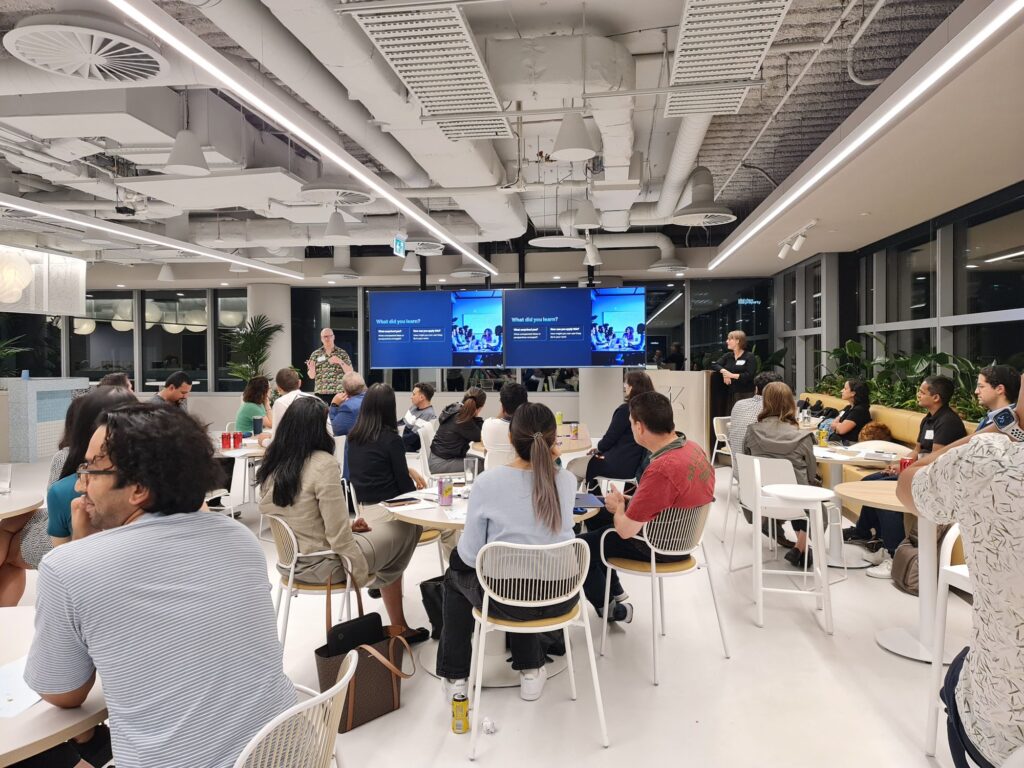
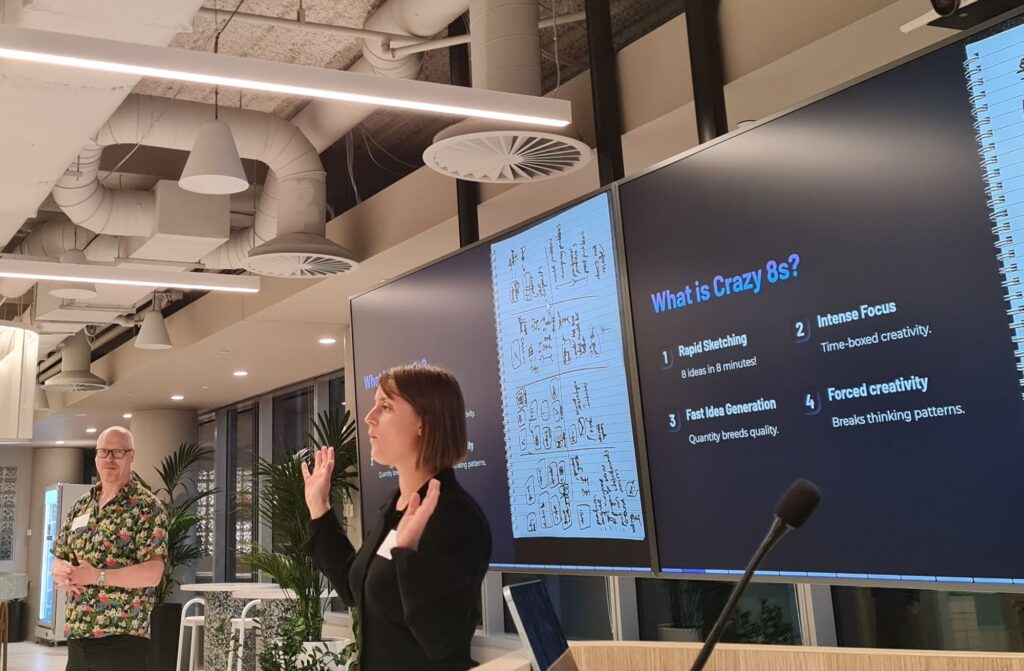
That’s exactly what our digital sustainability advocate KB (Katherine) Buzza set out to change at the Product Anonymous Melbourne meetup, armed with a copy of Tom Greenwood’s Sustainable Web Design and a lot of inconvenient data.
The message? Sustainability isn’t just an environmental issue. It’s a product problem – and product people are uniquely positioned to fix it.
The Sector We Don’t Talk About
Most of us are vaguely aware that data centers use energy. Few of us know the scale.
Research from Ericsson and university partners found that the information and communication technology (ICT) sector consumed around 4% of global electricity in 2020, accounting for 1.4% of global greenhouse gas emissions. That figure is projected to climb to 15% of global electricity by 2030 – driven by AI, surging data center demand and the sheer proliferation of devices.
A recent study from the French research organisation GreenIT.fr breaks down where that footprint actually lives:
- 60% comes from end-user devices – manufacturing, purchasing and running our phones, computers and (perhaps surprisingly) televisions
- 20% from networks
- 20% from data centers
The manufacturing and embodied carbon of our hardware is the single biggest lever. Not the cloud. Not the server. The device sitting on your desk.
This reframes the conversation entirely. The greenest phone isn’t the one with the best energy-efficiency rating – it’s the one you didn’t buy.

“The Cloud Is Material and Computation Is Metabolic”
Cloud anthropologist Stephen Gonzalez put it plainly: the language around cloud services has obscured the physical reality of information storage, creating a fantasy of infinite, weightless abundance.
There are no fluffy cumulus clouds holding your data. There are warehouses full of humming servers, cooled by enormous quantities of water, powered by electricity that may or may not come from renewable sources – often located thousands of kilometres from the users they serve.
Every query, every file upload, every forgotten duplicate in your S3 bucket has a material cost.
The AI Question Nobody Wants to Answer
Generative AI has supercharged this problem – and the companies building it aren’t being transparent about it.
None of the major generative AI providers have published clear environmental commitments. In their absence, a Washington Post study offered a useful proxy: generating a 100-word response via ChatGPT consumes approximately 500ml of water and the equivalent energy of leaving an LED light on for an hour.
That’s per query.
For teams that have integrated AI into their daily workflows – code review, documentation, customer support, sprint planning – the cumulative impact is worth thinking about seriously.
Big Tech’s Report Card
The talk took a candid look at four of the most common tech suppliers in the product world:
Microsoft Azure makes bold commitments – carbon negative by 2030, removing all historical emissions by 2050. But a former senior sustainability lead recently left the company citing a fundamental contradiction: Microsoft’s custom cloud work for fossil fuel companies is actively enabling greater extraction, potentially exceeding any carbon savings the company achieves elsewhere. Opening three new data centers a week compounds the challenge.
OpenAI has made no meaningful environmental commitments. Full stop.
AWS takes a more measured approach – fewer sweeping claims, but genuinely useful resources for builders who want to make greener architectural choices. Worth exploring if you’re making infrastructure decisions.
Atlassian earns the gold star. Their sustainability strategy document (cheekily titled Don’t F** the Planet*) is transparent, detailed and backed by action – including paying employees to use green energy at home and building Atlassian Central in Sydney, set to be one of the tallest timber-framed buildings in the world.
The Green Software Foundation’s Six Principles
For teams ready to embed sustainability into their practice, the Green Software Foundation offers a practical framework:
- Carbon efficiency – emit the least greenhouse gases possible for any given task
- Energy efficiency – use the least energy to perform that task
- Carbon awareness – schedule compute-intensive work when the grid is running on cleaner energy
- Hardware efficiency – minimise embodied carbon by extending device lifespans and avoiding unnecessary hardware
- Measurement – you can’t improve what you can’t measure
- Climate commitments – understand the actual mechanism behind any carbon reduction claim, not just the marketing
These aren’t abstract ideals. They’re engineering and product decisions that most teams already make – just without sustainability as a criterion.
What Product Teams Can Do Right Now
Here’s where this becomes an action list, not just a lecture.
Hardware and E-waste
- Extend device refresh cycles. Fight the instinct to push features that demand newer hardware.
- Repair over replace – a new battery costs less than a new laptop, in every sense.
- Dispose of E-waste responsibly. In Victoria, putting E-waste in landfill is illegal. Are your organisation’s policies keeping up?
- Measure how much E-waste your organisation generates annually.
Data storage
- Encourage a “digital spring clean” – delete what’s not needed, manage duplicates and archive rather than actively store stale data.
- Audit dead customer accounts. They’re a security liability and an unnecessary load on your infrastructure.
Renewable energy
- Ask whether your infrastructure runs on renewable energy. If you have a choice of cloud region, it’s worth factoring in.
Low-carbon design and development
- Reuse and repurpose content and code rather than generating from scratch.
- Choose efficient file formats.
- Consider the environmental footprint of your coding language choices – there’s a real hierarchy and it matters at scale.
- Ask where your data center is relative to your users. Proximity reduces latency and transmission energy.
Supplier interrogation
- Before renewing contracts with major cloud or SaaS providers, ask about their environmental strategy. Request transparency on water and energy consumption. The question alone shifts incentives.
The Business Case Is Already There
This isn’t just good ethics – it’s good engineering.
Sustainable software tends to be efficient software: leaner, faster, cheaper to run and more resilient. The principles that reduce carbon footprint also reduce infrastructure costs, tighten security posture and improve development velocity.
Sustainability, framed correctly, is a performance enhancer.
Product managers and developers sit at the intersection of every decision that determines a product’s environmental impact – from the infrastructure it runs on, to the features that drive device obsolescence, to the AI tools baked into the workflow. That’s not a burden. That’s leverage.
The question isn’t whether the tech sector will need to confront its environmental footprint. It will. The question is whether product teams will lead that conversation – or be dragged into it.

Resources:
Green Software Foundation – https://greensoftware.foundation/
Our Speaker:
KB (Katherine) Buzza’s career begun in marketing before embarking on a journey to discover how business can drive positive environmental and social change. Having worked across sectors, she has maintained a passion for sharing knowledge and climate positive solutions.
As a product manager for carbon account software company Climate Zero, she wants to keep expanding the conversation about sustainability in tech beyond data centres and decisions outside of our control.
Our Wonderful Host:

Chargefox is part of the AMS Group. Every day thousands of drivers charge their vehicle on the Chargefox network – the largest and fastest growing EV charging network in Australia. We’re owned and operated by the NRMA, RACV, RACQ, RAA, RAC and RACT. The same companies supporting drivers for over 100 years
https://www.chargefox.com/