January 23rd meet-up: Book club

The first session for 2014, will be a book club session.  

The book we will be reviewing is Decisive by Chip and Dan Heath. Don’t worry, you don’t have to read it to enjoy/come to the session, but if you do wish to get a copy at Amazon (ebook is available) – here’s the link*: Decisive: How to Make Better Choices in Life and Work

This book and its content follows on from our session on Decision making in June last year, which Steve then put together a series of posts diving in deeper to the issues he raised during his session.  You can find the start of the series here and there are six articles in total.

The main treatise of the book is about the psychology behind the decision making process.  The great thing thing about the Heath brothers work, is they provide real insight into ways to actually start doing better at our own decision making and helping others to do so as well.  As product managers this type of influence is critical to what we do.

If you would prefer the cheat sheet reading approach, check out some of Teresa Torres‘ articles about this book and the elements that resonate for her and product management.  We will take a look at some of this work as well during the session.

January 23rd meet-up: Book club on Decisive by Chip and Dan Heath. Start time 6pm, for 6:30pm kick-off, at the Mail Exchange Hotel, back room behind the Restaurant area. Bourke and Spencer st.
RSVP below or click this button to go to Eventbrite for full details

Eventbrite - Product Anonymous - January 23 - Book club


*testing an affiliate link so if you buy via this link Product Anonymous will get something like 10c which will go towards hosting costs.

End of the year events

We have 2 more events before the end of the year so hope to see you – at least once!!

This month’s evening event is our annual social. There’s no speaker, no specific topic – it’s just all about chatting, catching up, talking product management (or not) and getting to know each other better. It’s also Product Anonymous’s 2nd birthday!!!!

This year our end of year social is Thursday Nov 21st at the Sahara bar on Swanston st. Sign up here: 
Eventbrite - Product Anonymous Coffee - October 31

And then we’ll finish off the year with an afternoon coffee on Thursday Nov 28th, 2-3pm, City Square by Brunetti’s. Drop in any time when you can, we will be there the whole hour. Sign up here: 
Eventbrite - Product Anonymous Coffee - October 31

Oct 24th write up – Digesting the IDEO +Acumen HCD course

The IDEO +Acumen+ HCD course is a do-it-yourself group course which in 6 weeks runs you through the entire IDEO design process for Human Centred Design. The course is sponsored in Australia by +Acumen, which is an organisation that helps people self-learn.

We had a big crowd for this session, and when circling the table to see what attracted people we had about a third who had done the course and were interested in unpacking it with others who had done the course and a third who had experience in human centred design and the last third interested in understanding the value of doing the course themselves.  It was a good mix of people to encourage good discussion throughout the presentation.

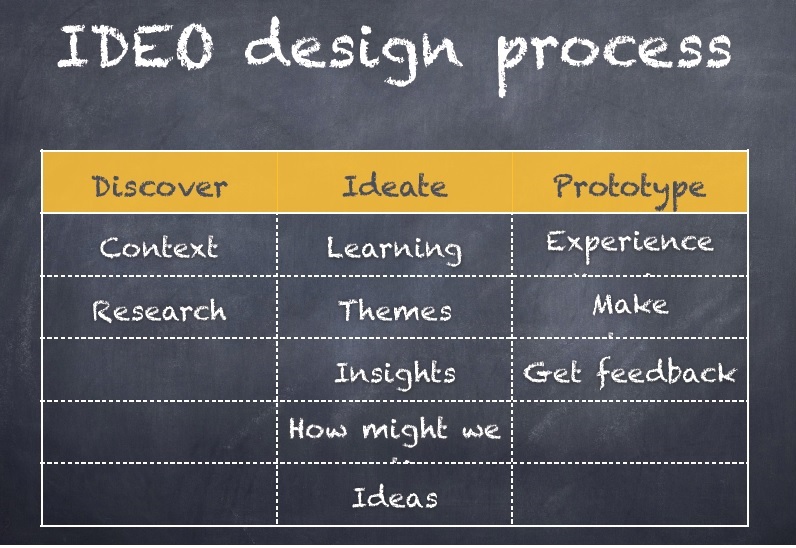
IDEO’s design process covers three areas: Discover, Ideate and Prototype.  Within each of these areas there are levels which are quite important breakdowns of the process.  By understanding these smaller elements, you begin to get an appreciation for a robust and repeatable process, which still has the flexibility and room for customisation to be applied to any project.

Includes the sub-steps in each of the stages of Discover, Ideate and Prototype

Includes the sub-steps in each of the stages of Discover, Ideate and Prototype

The Discover phase can iterate between research and context for a time until you are comfortable you know what you are pursuing before moving onto the Ideate stage.  Within Ideate, you can progress along – whilst repeatedly revising your direction – until the point where you consider heading towards Prototyping.  As we were on a course, we followed a VERY linear path, but those who had experience with this approach called out that you might stay in an area of focus for a long period until it was right or you might be very structured but repeat from start to finish each week.  It depends on the project, the team and the overall goals you may have when applying this approach.

It was a great part of the discovery to understand the more discreet steps within each area and learn ones strengths and weaknesses at each.  For example getting out there and just asking people questions was hard to get going, but once you started and found that people are amazingly open and willing to share their thoughts it got easier.

One of the complaints regarding the course was that it took far more time than indicated. One of the group at the session didn’t complete it as they struggled to keep momentum going after 6 or 7 weeks and not being in sight of finishing.  The group I was with came very close to giving up, but we managed to rally to get to the finish line.  We also made a conscious decision to skip some elements in order to see out the course to the end.

Once my group got to the brainstorming stage we as a group had one of our best grok moments of the course.  We found that it wasn’t so hard to generate ideas, by having everyone think out loud so we could build off each other – the faster we shared “conventional” ideas the quicker we got to better ideas.  Once we were done it was quite easy to spot the good stuff.  With only the option to score on achievable and innovative and one vote per person per criteria the “winners” bubbled up quickly.  This methodology for group focus on progressing ideas to prototyping was fabulous.

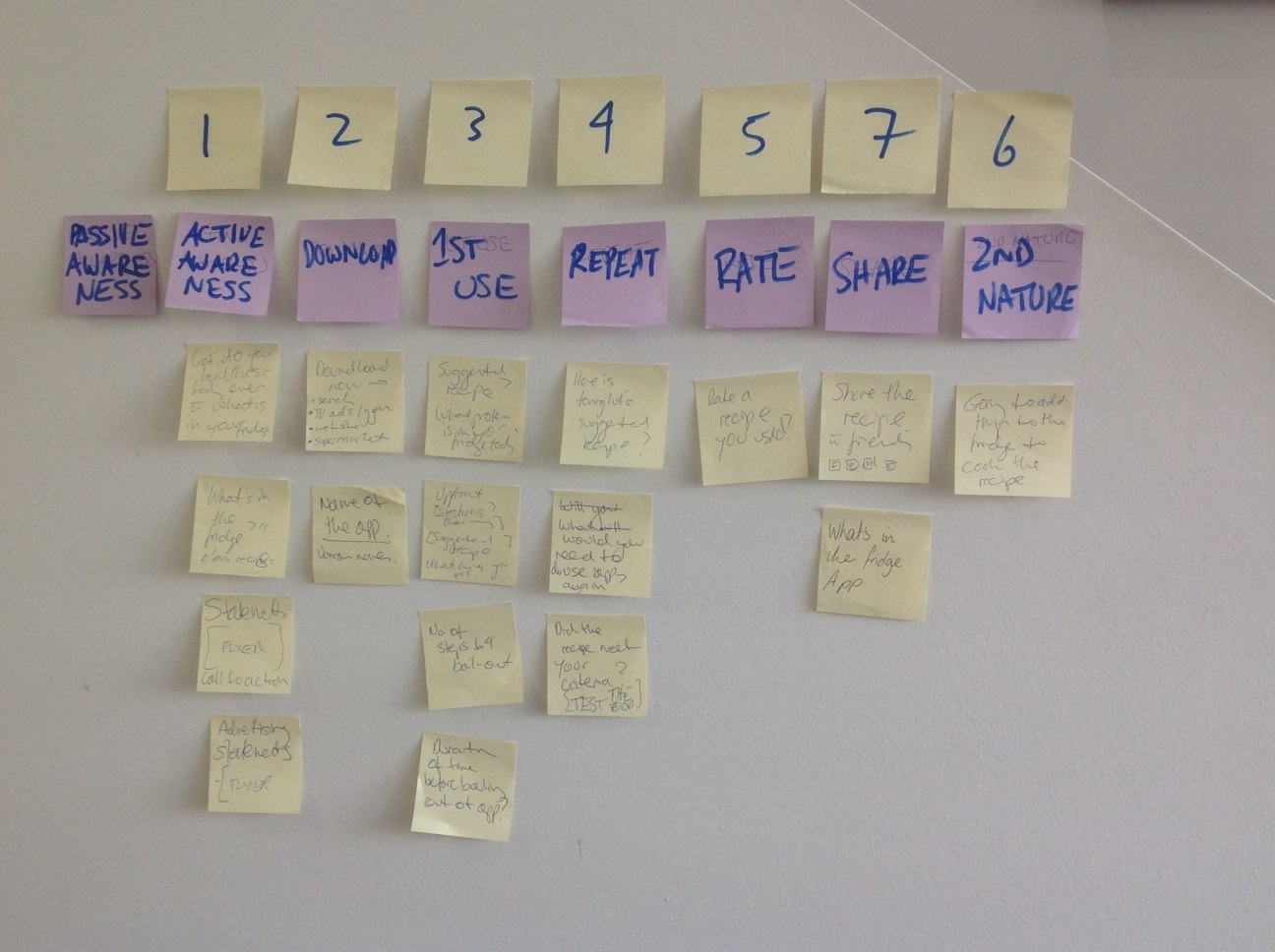
The last stage was Prototyping and I must admit I thought we would immediately start to build and kind of get creative right away.  I was impressed with this stage having a scientific approach that ensured you tested an idea rather than the whole product.  The user experience map was a great way to break it up into small achievable steps, whilst at the same time understanding your goals and vision for an end state product or service.

A photo of our experience map during our Prototyping workshop

A photo of our experience map done during our Prototyping workshop

This was the moment this course struck gold for me for as a product manager.  I think these elements are used commonly in product management (testing, revising, build at “story” level) but the insight here was that you need to test a step in the user experience before committing to the whole product.  The other insight was that prototyping does not need to be such an expensive fully designed product, but something light (easy to throw away!) such as a story, a diagram or an ad.  These options allow for prototyping without development and can be really useful at many stages of the product management lifecycle.

As Steve highlighted, even before you have a team, and before you have money, and when you need to make the case for the business case this no cost prototyping brings the validation to get your next idea across the line.

Some additional thoughts are called out in the deck below. Please feel free to add your comments or questions below if you have done the course or have your own experiences with this methodology.


Sept 26th write up – Wèishéme (Why)

For those who don’t know, I’ve been overseas the last few months – mostly in Shanghai. Being in a new city with such a different culture to my own (even my adopted cultures), I found I was constantly asking ‘why’ on a very regular basis.

I was taking mandarin classes learning how to ask ‘what’ and ‘where’ but what I really wanted was to ask ‘why’. I kept seeing all sorts of scenarios where I wanted to ask ‘why’! For example, why do some foods need to be wrapped in layer upon layer of plastic wrap when meat was available for sale unrefridgerated on a cardboard table?

Although even after I learned the word for ‘why’ – wèishéme – I knew I wouldn’t be able to understand the answers (my mandarin has improved but it’s very much a work in progress!). I became a little obsessed with wèishéme and it got me thinking about asking the question in product management.

Whether we’re talking with a customer or end user, determining which feature to build next or how to market our product, understanding the ‘why’ is needed to help us connect, make our products great and create success. Understanding ‘why’ uncovers the value and explains why we care, what the context is, influences us and focuses on the problem (not the solution).

We can integrate ‘why’ into our existing tools like positioning statements, interviews & research, and even agile stories.

Some of the references include:

Simon Sinek’s ‘Start with Why’ TED talk & the golden circle

Bill DeRouchey’s ‘Power of Why’ deck on slideshare

Steve Portigal’s Interviewing Users: How to Uncover Compelling Insights

I’d also recommend The Power of Habit: Why We Do What We Do in Life and Business. It didn’t make it into the deck but is an excellent read.

Product Anon Coffee – Oct 31st

At our last meeting, you told us you wanted #prodgmt than just once a month!!  Out of this conversation and other feedback we’ve had, we’re trialing a monthly coffee/lunch session.

We held our 1st coffee session on the afternoon of Oct 3rd.  It was good to see both new & familiar faces stop by (note to self: must remember to take photos!!).  The concept of being able to pop in for a few minutes or have a leisurely coffee seems to be a winner.

We’ll be mixing it up with different times (& maybe get crazy with a different day!) so keep that feedback coming!    On the 31st,  our coffee session will be more of a lunch time affair.    We’re hoping for some good weather so we can all meet in a park but let’s see closer to the date.   Venue suggestions are welcome!!

Our next Product Anon coffee will be Thursday Oct 31st, 12:30-1:30.   Subscribe to our google calendar / Twitter / Linkedin for updates.

Eventbrite - Product Anonymous Coffee - October 31

October 24th Meet up – Digesting the IDEO + Acumen HCD course

IDEO and Acumen offered the chanced to do an online course on IDEO’s human centred design process.  All you needed was a bit of time and at least one other person to sign-up with.  I gathered a group of fellow product managers and Product Anon attendees and we signed up to give it a go and learn more about this leading process for innovation.  They will join me for the session to share from their point of view as well.  

This month’s session will be on how we found the course, what we learnt, how we will try and fit it back into our Product management worlds, and how we will keep our minds open. If you took the IDEO/Acument course, please come along and share your experiences.

The usual location – Mail Exchange Hotel on the corner or Bourke St and Spencer st.  This is the last topic event before we have our end of year Product Bash. Sign up here.

Eventbrite - Product Anonymous - October 24 - Digesting the IDEO + Acumen HCD course

October is Bring a Buddy month!!! Do you have a friend, co-worker or colleague from a previous job who you think might be interested in Product Anonymous? Someone who has asked about the group but never comes along? We’ve heard from some people that they’d like to attend but don’t know anyone at Product Anonymous … so they don’t attend. This month, think about who you know would be interested in the group or topic and bring them along! Be a buddy!

The Art of Decision Making – Part 6: Decision time

This article continues the discussion from Product Anonymous back in June.  Full credit goes to the team and the attendees for providing key steps, insight and critical analysis.

In the last set of posts we defined the problem (topic and people), identified some alternatives, and evaluated those alternatives.  Step #4 in the process is to decide between those alternatives.

With all the evaluation you did in the last section, it should be pretty clear what the correct decision should be.

Some extra thoughts on the actual decision point.

Sometimes it is hard to make a decision.  You will need to balance the upside against the downside.  For quantitative information this may be a mathematical decision, but this is unlikely to be the only part.  Since there is always a human element there will be additional complications to resolve.

A good decision should not be a surprise to anyone. Certainly the easiest decisions are those that don’t seem like they were required.  If anyone is surprised then it is likely you haven’t done your homework in building engagement and consensus.  Everyone should understand that they had a part in the decision, that their opinions and ideas were listened to, and they all got the right background.  Everyone should see the decision as a natural evolution out of the options and the situation.

Sometimes it is easier if you decide on what you’re not doing.  Striking off alternatives that you aren’t going to do, and see what you are left with.

Will the decision stick?  The previous sections discussed the RACI analysis – if the decision is not being supported by the right person then it might not stick – and therefore it won’t be the decision that was needed.

Is the water clouded with too many issues?  Whenever there is “Fear, Uncertainty and Doubt” (FUD) then it will become hard to make the decision.  Clear up any misunderstandings by going back to first principles.

What would it take for me to believe in the decision?  Are you personally convinced this is the right way to go?  Or are you going by the numbers?

Are you looking for something that is the optimal decision or just good enough?  Some people (known as maximizers) will spend a lot of energy optimising a decision, while some people (satisficers) will simply try to get by with a possible solution.  Which one are you?

How will you feel about the decision in 10 minutes, 10 months and in 10 years?  Using this tool is a good way to separate yourself from the emotional here-and-now of the decision

Is there some form of personal fear in your decision?  We all experience fear of failure and fear of getting it wrong.  This is normal.  But if this is your product, you need to be proud of your decision, regardless of your fear.

Is it fear that this is a one-way decision?  Such decisions are rare, and many can be corrected.  And if other people are part of the decision process then they will help.  Especially if you have called out assumptions, then they can recognise that change will need to be made.

If you can’t decide then maybe it doesn’t matter.  Maybe everything has an upside and a downside that can’t be compared – so every option is good and bad. In which case the option chosen doesn’t matter.  But still make a decision because you need to set a direction.

If you can’t decide, then try the ‘slightly cranky’ method.  This is the time to channel your inner cranky product manager.  Pretend you have been at this all night and you have had enough?  Now what?  Evaluate and check that it makes sense at the end though. You are effectively trusting your gut now, so look inside and work out the things you decided were most important, and use these for your reasons.

Doing the exact opposite might still be valid.  Can you flip it on its head?  This can be such a big mental shift that you will probably need to explain the reasoning to everyone again.

So we now have some well evaluated alternatives, we have though about the implications and finally it is crunch time.

You have to make a decision.

Do it.

We have a decision, but it is not over yet.  You will need to implement it, and then learn from it.  Next we’ll look at the implementation.

Have you got any other tools to help you make decisions? Please feel free to comment below to add to the discussion.

Go back to Part 5: Evaluating Alternatives

Steve is a Product Development Manager at Telstra Wholesale.  The views expressed in this post are his only and do not necessarily reflect the views of Telstra.

You’re invited to our first #prodanon coffee

At Thursday’s meeting, it was suggested we host a monthly coffee so we’re giving it a go this week.   Thursday Oct 3rd from 2-3pm in the CBD.  Location details below.

The idea came as an alternative for people who can’t attend in the evening and/or want more than just 1 time a month to talk about product management.

Our evening events have time to meet people & chat although we always have a topic for discussion.  With the coffee session, it’s purely all coversation on whatever topic you want.

We hope to see you there!  We’d love your feedback on this idea too!

Thursday Oct 3rd at Captains of Industry at 2 Somerset Place Lvl 1 from 2-3pm.   We’ll have some sort of signage to indicate Product Anonymous (ie showing our logo).

View Larger Map

The Art of Decision Making – Part 5: Evaluating alternatives

This article continues the discussion from Product Anonymous back in June.  Full credit goes to the team and the attendees for providing key steps, insight and critical analysis.

In the last post we identified more alternatives that might address our key issue.  Step #3 in the process is to evaluate those alternatives.

You’ve got your problem identified, and you have alternatives A through Z. How are you going to evaluate them?  You probably have a gut feel already, but how can you do this more rigorously?

“The great thing about fact-based decisions is that they overrule the hierarchy.”
Jeff Bezos

Get them on the table.

List all the alternatives together – preferably on one page.  People find it easier to do comparisons if they can just flick through with their eyes.  If you have more than one page then you risk people not being able to remember details as they skip between pages.

Clarify each alternative so that everyone is sure they are talking about the same thing.  Perhaps you could just verbally describe each and highlight any differences.  Or alternatively document each alternative with a detailed description.  It is better to find any misunderstandings early.

Decisions are limited by assumptions.  Without proper attention, humans tend to make poor assumptions, if we even realise we make them at all.  Call out the assumptions to the team or in the document. Test the assumptions, get the reactions and feedback, and clarify if necessary.  Perhaps you’ll discover your assumption was wrong.  Again, it is better to find any misunderstandings early.

Finding a valid way to compare alternatives can be hard

Comparisons can be complicated, as you are rarely comparing apples with apples.  You will need to find ways to compare your alternatives.  This can be done in a few different ways, and the choice of comparison can be as complicated as the original list of alternatives.  But if you need a decision, then you first need to find a valid way of comparing your alternatives.

Note that evaluating alternatives is another opportunity to engage with your stakeholders.  While this could be formal meetings, it could also be over a coffee with some of the stakeholders to gain their insight.  It also has the potential to open up new ways of evaluating, build a better decision, create support and unearth the hidden ‘gotchas’ and opposition.

Cut back the options

More options means more attention, more short-term memory usage and more multitasking between different evaluation methods.  Attention and will power are both exhaustible resources, and too many options can be quite draining – possibly leading to analysis paralysis.

For example, what does the product strategy, corporate strategy or vision have to say about your alternatives?  If some of the alternatives don’t align with the overall goal then perhaps you should rule them out from the current list.  If these alternatives are compelling but disagree with the strategy then you may have a lot of work ahead to pivot, change the product strategy or corporate strategy.  It might be perfectly valid, but you probably have even more work ahead.

Make a first pass and cut down the number of options to something manageable – perhaps three to five of the best options.  Make sure the status quo is one of the options.  Identify the options that are being discarded, and be clear why they are being excluded.

Optimise for one thing

Ideally, work out one thing you are trying to optimise (people, costs, adoption, etc.), and stick with that.  If you try to combine different variables and comparison methods you risk going to go into analysis paralysis; when do you optimise for X, when do you optimise for Y?  Sort and list you remaining alternatives using only your chosen optimisation.

Dan Ariely and relativity

Dan Ariely has written quite a lot about behavioural economics, and especially how people don’t know what they want unless they see it in context.  Watch his TED talk to see how the addition of a third decoy option can make one option more compelling than another.  In his example it is hard to compare a holiday to Paris against a holiday to Rome.  But when you add a third option that is just worse than a holiday to Rome (Rome without coffee), then the Rome option becomes even more appealing.

The way out of this irrational behaviour is to take a more scientific approach, and try to be more objective.

Quantitative versus Qualitative?

When evaluating the alternatives some people will want quantitative evaluation; numerical data driven evaluation.  This can range from counting events, calculating Return On Investment (ROI), applying weighted averages, opportunity cost or even conjoint analysis (my favourite).

The reasoning is that numbers don’t lie, and that an objective decision can be made.  Unfortunately quantitative data usually has some human element and can be misled, either intentionally or not.   As the saying goes ‘lies, damn lies and statistics’.  The reality is you can still choose the statistic or assumption that supports your cause.  And if someone doesn’t want to believe your numbers they can always dispute whether the data source is relevant or whether the weighting is correct.

Quantitative data can prove correlation, but it can rarely prove causation.  Even qualitative data can only indicate causation.  My favourite example is the theory that lack of pirates is leading to global warming.

While quantitative data can be compelling, it won’t be the whole answer.

The decision may require a more qualitative evaluation; what is the impact on people, is it important to the company, what is the customer feedback?  My personal favourite is the ‘jobs to be done‘ analysis; what was the customer hiring the product to do?

Qualitative data will always be disputable as it isn’t ‘hard data’ but it is often necessary in small sample sizes or when people are directly involved.

The plural of anecdotes is not data
Frank Kotsonis / Roger Brinner.

The plural of anecdotes is data. 
Raymond Wolfinger

Apparently both are quotes (and self-referential proof that quotes are also not data).

Statistically, for small amounts of anecdotes, the plural of anecdotes should not be considered statistically significant data.  But just because the sample size is too small doesn’t mean the anecdotes should be completely ignored.  Given a large enough set of inputs, then the anecdotes start to become data where overall patterns can be identified.

Sensitivity analysis

You can perform additional sensitivity analysis on your alternatives to assess whether your comparison is solid.  One example is when you adjust the weighted averages by +/- 10% to check if it makes a difference on the outcome.  If the outcome changes then you are too dependent on the fine details of the weighting and the input data and will not have a stable and reliable answer.

Compare

Use a combination of techniques to narrow the list, perform some quantitative analysis and qualitative research.  The list should now be manageable for the next stage – decision time.

At the end of this evaluation you may even have a document.  For a large enough decision, team or project, this becomes a bit of a strategy document.  Circulating this document as a draft or straw man helps give people a chance to get on the same page and build consensus.  It gives people a chance to comment further if they’d like.

Now… a final question.  Is that gut feel answer suddenly now the best alternative?  You may need to question whether you are doing this objectively. You may be suffering from confirmation bias, where people favour information that confirms their own beliefs.

Hopefully now you have option A to Z cut back to a manageable size of less than 5 options.  The next step is deciding between them. 

Have you got any suggestions in ways to evaluate alternatives? Please feel free to comment below to add to the discussion.

Read part 4 on identifying alternatives or go forward to part 6 on making your decision.

Steve is a Product Development Manager at Telstra Wholesale.  The views expressed in this post are his only and do not necessarily reflect the views of Telstra.
The Art of Decision Making – Part 4: Identifying alternatives

This article continues the discussion from Product Anonymous back in June.  Full credit goes to the team and the attendees for providing key steps, insight and critical analysis.

In the last two posts we talked about defining the problem and addressing the right stakeholders.  The next step in the process is to identify some alternatives.

You’ve got your problem identified, and you immediately think of alternatives A, B and C. Is that enough?

What are the unwritten alternatives?

Remember that the status quo is an alternative, and not necessarily a bad one.  Any changes should always be judged against the current operation.  You need to justify why the new solution is better than what you have now.  After all, what you are doing now probably worked for a reason.

What about alternatives that allow you to learn quickly or even fail fast?  A clear decision to research an issue (by allocating a small amount of resources within a short time frame) might be the best way forward in a complex situation.  The research project may fail, but at the end you will be in a better place than before.

Delaying the decision is also an alternative, but be careful that you are not just being indecisive.  Product management is about getting out there, deciding on product issues and then making sure it happens – product managers are naturally biased towards action.  Sometimes it can be too early to decide; either you don’t have enough information or a short delay will have no effect.  It is important that any delay should be for a good reason (i.e. key information will become available), and not just due to indecision.  Not only is indecision bad for the project, it is bad for the team.  Your team needs to see you as understanding the problem and not just delaying everything until it is too late.

Valid alternatives can also include areas of uncertainty; either the details can be worked out later, or the uncertainty won’t have a big impact. Both Waterfall and Agile use this uncertainty, but in different ways.  Waterfall might simply define high level requirements without defining how they will be implemented, while Agile might define a solution for the current sprint but not expect it be the final solution.

Get out and ask a customer. 

If possible, get out an investigate the market place.  How have your competitors or customers solved this question in the past? For a more lateral approach, identify a related industry and look at how they solved issues. Remember that Nothing Interesting Happens in the Office (NIHITO).  This is a good time to collect some new ideas as well as the usual ideas.

A desk is a dangerous place from which to view the world.”
– John le Carre

Sources of ideas

The obvious way to identify alternatives is brainstorming.  This can be the classic ‘get everyone in a room’ method, or it could be a simple chat with a colleague.  The usual brainstorming is to be completely open, or it can be bounded towards the alternatives required.  Both methods have merit, but I prefer everyone facing the same direction.

One way of doing this is SCAMPER which prompts people to alter different aspects of a product.  SCAMPER is a mnemonic that stands for:

  • Substitute.
  • Combine.
  • Adapt.
  • Modify.
  • Put to another use.
  • Eliminate.
  • Reverse.
An example of applying each of these is on the great MindTools site.

(Brainstorming is such an interesting  and detailed topic that I’ll leave it to another blog post)

Your team and colleagues are naturally a good source of ideas for alternatives, and this is also a good time to share decision making with the team.  Ensure you get their ideas and input will help them feel like they are part of the process.  It is also a good coaching opportunity to involve newer or junior team members.

Larger projects will now start their process of generating buy-in.  Start early.

This is a good time to start any engagement and, if necessary, pre-meetings.  These are less-formal meetings where you socialise an issue and build consensus among your stakeholders and team.  Identifying alternatives is a good place to start involving the right people at an early stage.  The challenge is working out who are they.  You may get someone from the shop floor who may give great insight into what might go wrong, or they just become baggage by sticking to the “ways we do thing around here.”  Start with the RACI list you generated in the last section.

If it is for large decision making or large corporates, then ensure that all the alternatives are writen down.  Not only does this help formalise and share the alternatives, some extra thinking goes into writing things down.  Your brain needs to choose words that represent your thoughts and it is only when the ink hits the page do you discover whether you are using the right words.  This is just like those times you have to explain something to a bunch of people – it is only then when you discover you don’t really understand the topic.

Hopefully now we have more than options A, B, and C.  There are lots of alternatives out there.  Some of them are right in front of you, and some may need some new innovation.  After we consider the above, we should have D, E and F now. The next step will be evaluating those alternatives.

Have you got any suggestions in ways to generate alternatives? Please feel free to comment below to add to the discussion.

Go back & read part 3 on defining the people in the problem  or go to part 5 on evaluating alternatives

Steve is a Product Development Manager at Telstra Wholesale.  The views expressed in this post are his only and do not necessarily reflect the views of Telstra.